Ice core records of Carbon-14 of carbon
monoxide from Law Dome to reconstruct
atmospheric oxidation
2019 Project Update - Antarctic Fieldwork Completed!
|
|
As of late February, 2019, the major fieldwork component of the Law Dome 14CO project has been completed! After spending more than 100 days in Antarctica from November 2018 through February 2019, a team of US and Australian scientists and support staff successfully drilled just over 1000 meters of ice cores at the Law Dome "DE08-OH" high-snowfall site. Large-volume (up to 60 standard liters) air samples dating to as old as the 1870's are currently traveling across the Pacific Ocean back to the USA for preparation and analysis...
This project is a collaboration between the University of Rochester, the Commonwealth Scientific and Industrial Research Organisation (CSIRO, Australia), the Australian Nuclear Science and Technology Organisation (ANSTO), Scripps Institution of Oceanography, Oregon State University, and the University of Washington.
We'd like to thank the US National Science Foundation (Award 1643669) and the Australian Antarctic Division for funding and logistical support for this project. We are also grateful to the wonderful people of the 72nd Australian National Antarctic Research Expedition at Casey Station.
2018 Project Overview
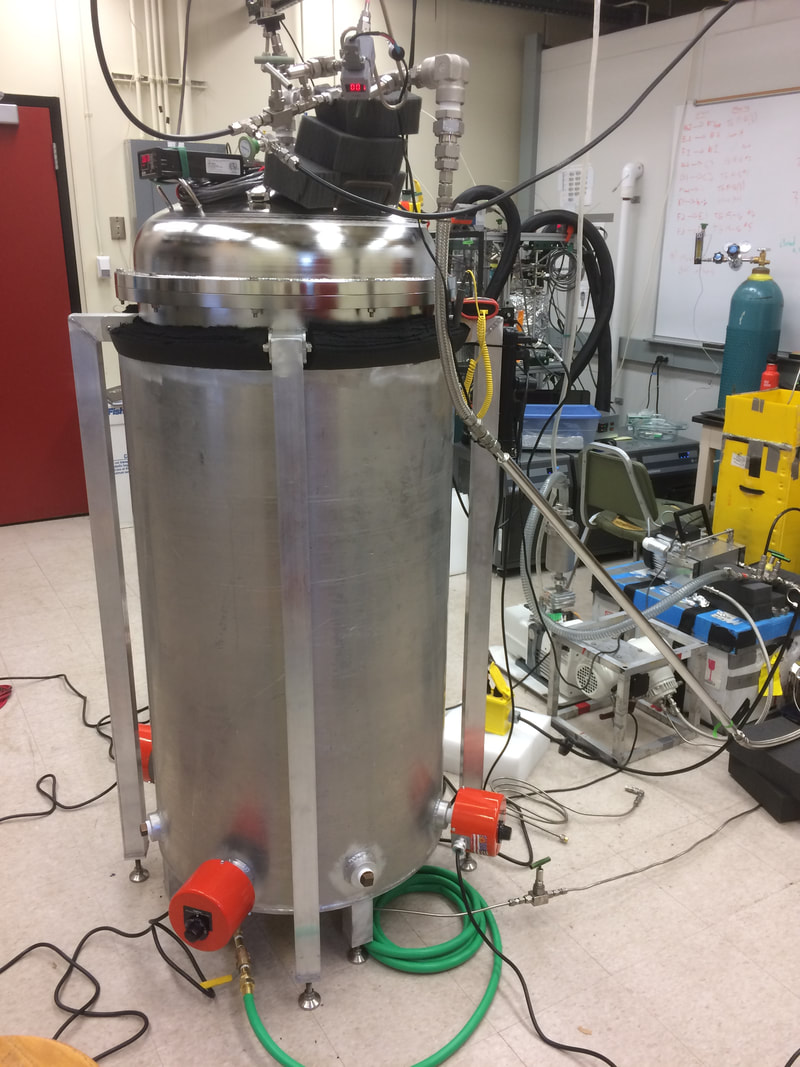
Large volume vacuum chamber and water bath for melting ice cores and extracting trapped air.
|
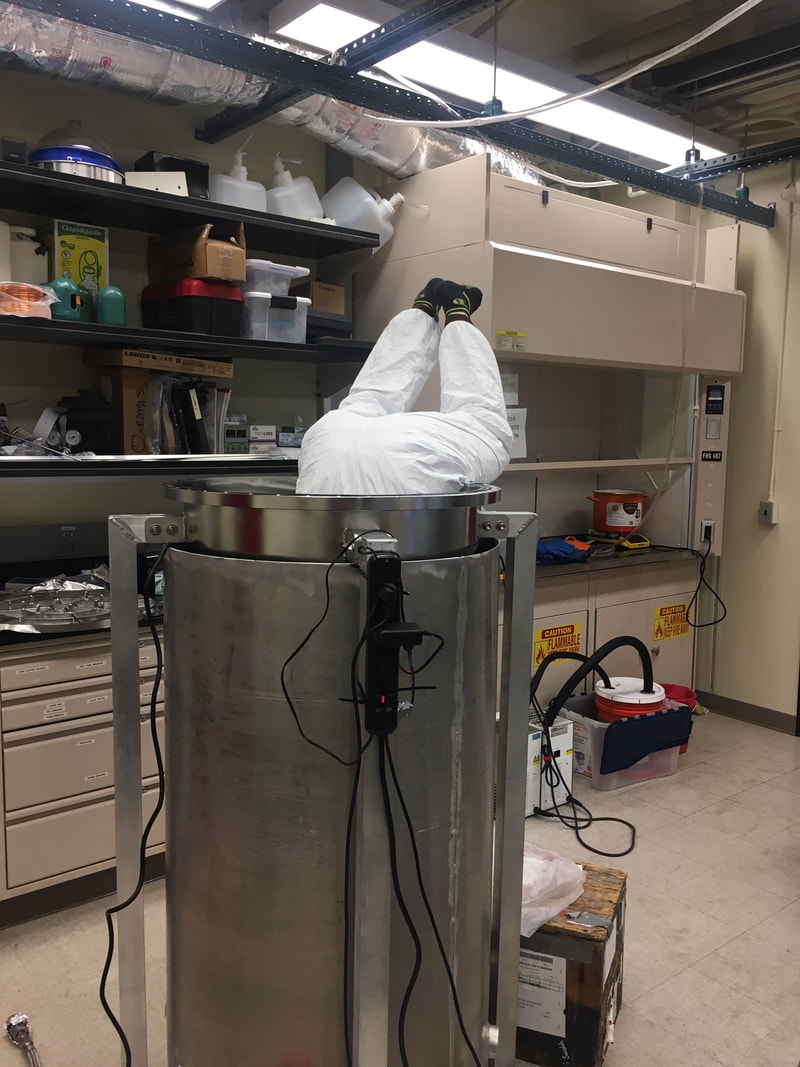
What does not belong in the "melter." Photo Ben Hmiel.
|
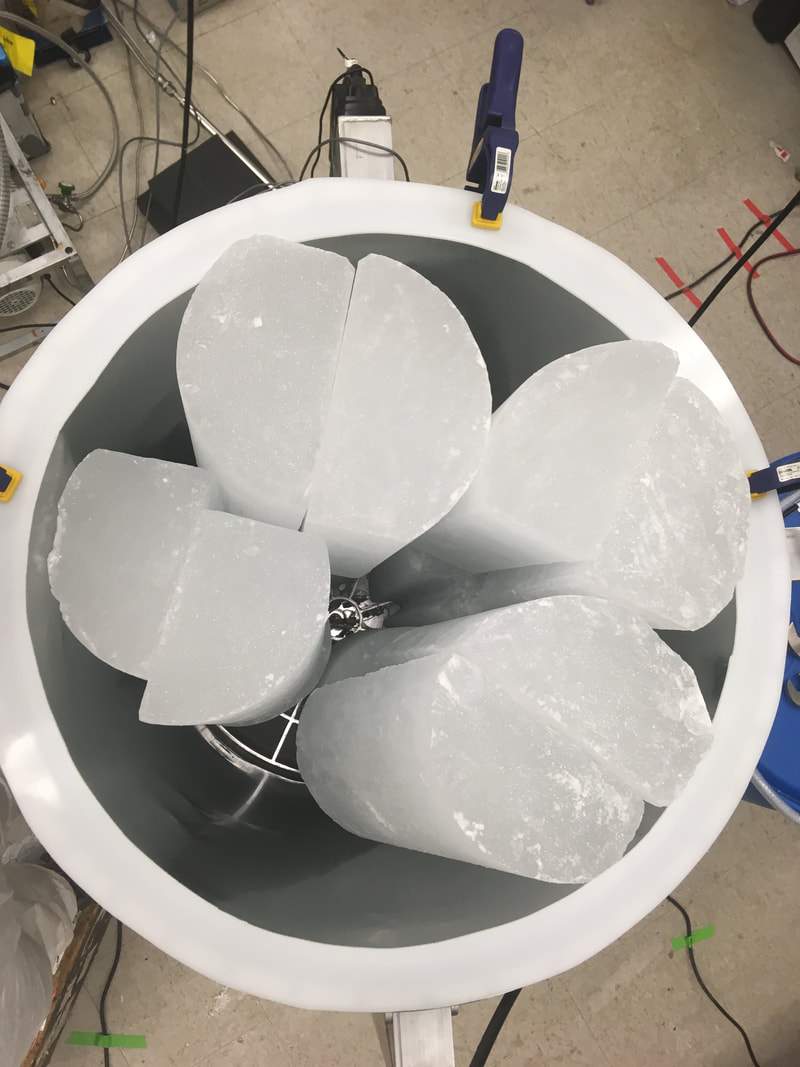
What does belong in the melter: Antarctic ice cores. Photo Ed Crosier.
|
My work with Vas Petrenko at the University of Rochester Ice Core Lab centers around the use of Carbon-14 of carbon monoxide (14CO) as a tracer for hydroxyl (OH), which is the primary oxidant in the atmosphere. More simply, OH is the cleanser of the atmosphere and determines how long trace gases like methane (CH4) stay in the atmosphere. The longer a methane molecule stays in the atmosphere, the longer this greenhouse gas has to warm the atmosphere.
Unfortunately, we can't directly measure OH (it has a 1-second lifetime) and we have very little knowledge about how it has changed in the past. 14CO, however, is stable in the atmosphere, has a known source (cosmic rays), and is almost entirely destroyed by OH. So, by measuring 14CO and modeling its production we can attribute observed 14CO differences from expectations as changes in oxidation by OH.
How do we get 14CO samples before atmospheric measurements? Luckily, firn--the porous upper 100 meters or so of polar ice sheets (a 15-cm section of which is pictured in the header photo)--has been trapping samples of the atmosphere for millennia. We plan to measure 14CO trapped in Antarctic ice cores to reveal the history of atmospheric oxidation over the past 150 years.
14CO in ice has the added complication that some 14C is produced "in-situ" as the ice sits near the surface of the ice sheet, due to bombardment from secondary cosmic rays. To get around this, we have proposed to travel to a location with one of the highest snowfall rates in Antarctica: the "DE-08" site on Law Dome in Australian Antarctic territory. The high snowfall quickly shields ice from in-situ production, thus minimizing this undesired 14C component. For more on 14C production in ice, see Petrenko et al., 2016.
To get enough carbon for accelerator mass spectrometer measurement, we need about 300 kilograms of ice. We have designed and built a stainless-steel chamber with a hot water bath to melt and extract old air from the bubbles trapped inside the ice. This will travel with us to Antarctica, allowing us to extract gas samples in the field and ship them home.
Unfortunately, we can't directly measure OH (it has a 1-second lifetime) and we have very little knowledge about how it has changed in the past. 14CO, however, is stable in the atmosphere, has a known source (cosmic rays), and is almost entirely destroyed by OH. So, by measuring 14CO and modeling its production we can attribute observed 14CO differences from expectations as changes in oxidation by OH.
How do we get 14CO samples before atmospheric measurements? Luckily, firn--the porous upper 100 meters or so of polar ice sheets (a 15-cm section of which is pictured in the header photo)--has been trapping samples of the atmosphere for millennia. We plan to measure 14CO trapped in Antarctic ice cores to reveal the history of atmospheric oxidation over the past 150 years.
14CO in ice has the added complication that some 14C is produced "in-situ" as the ice sits near the surface of the ice sheet, due to bombardment from secondary cosmic rays. To get around this, we have proposed to travel to a location with one of the highest snowfall rates in Antarctica: the "DE-08" site on Law Dome in Australian Antarctic territory. The high snowfall quickly shields ice from in-situ production, thus minimizing this undesired 14C component. For more on 14C production in ice, see Petrenko et al., 2016.
To get enough carbon for accelerator mass spectrometer measurement, we need about 300 kilograms of ice. We have designed and built a stainless-steel chamber with a hot water bath to melt and extract old air from the bubbles trapped inside the ice. This will travel with us to Antarctica, allowing us to extract gas samples in the field and ship them home.
|
|
Header video courtesy Richard Smith.
